
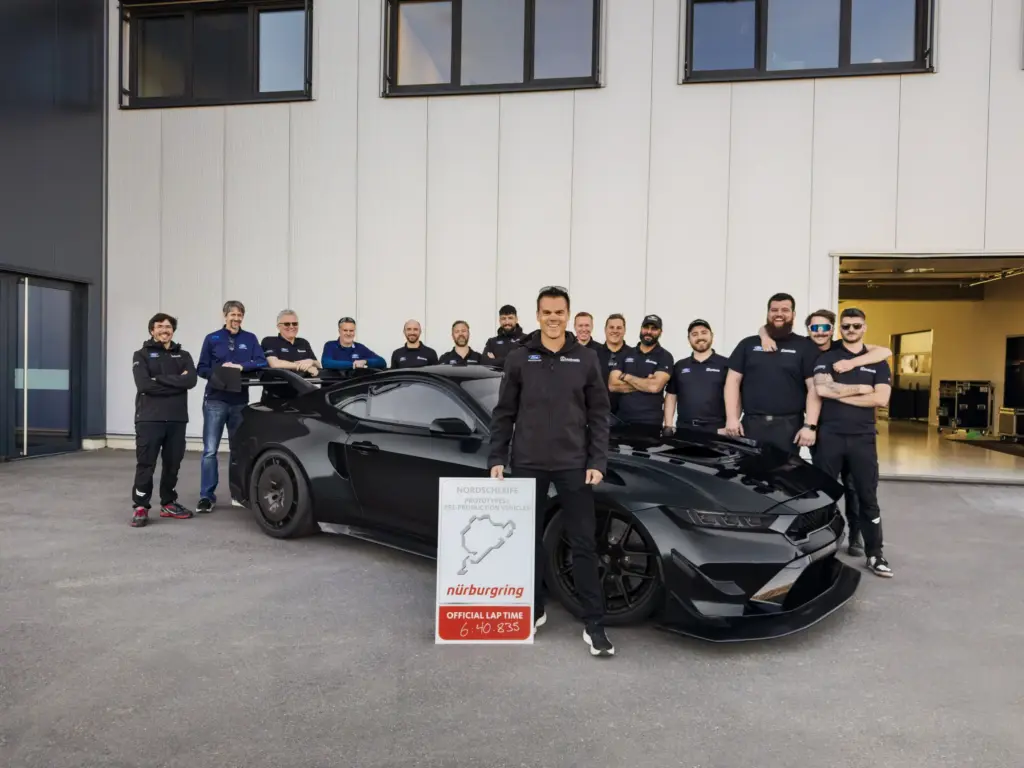
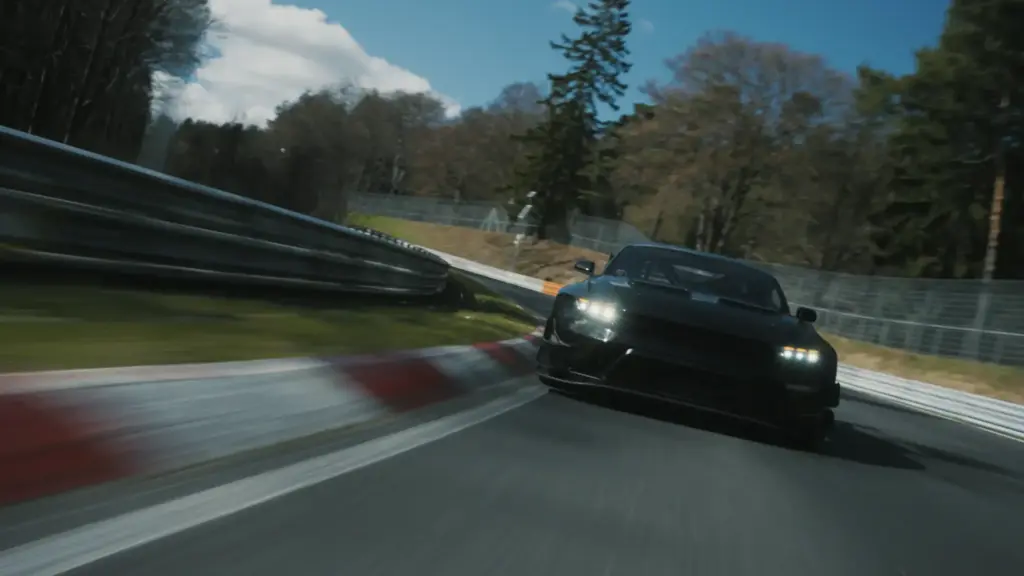



Ford has returned to the Nürburgring with a harder-edged version of the Mustang GTD and found a meaningful chunk of lap time. The new GTD Competition has recorded a 6:40.835 around the Nordschleife, cutting more than 11 seconds off the GTD’s previous benchmark.
That is a serious improvement at a circuit where time is never found cheaply. It also gives Ford a useful win in its latest duel with Chevrolet. Beyond that, though, some perspective is needed.
This is not an outright Nürburgring record story. Nor is it some great reset of the performance-car hierarchy. What it is, is a very fast lap by a road-legal Mustang-derived machine on the world’s most demanding circuit. That alone gives it weight.
Dirk Müller was again at the wheel for the headline run, while Ford Racing engineer Steve Thompson also lapped the GTD Competition in 6:49.337. That second number matters more than it may seem. It suggests the improvement is built into the car, not merely extracted in one ideal lap.
Ford says the GTD Competition sits sixth on the Nürburgring’s Pre-Production and Prototype leaderboard. That is impressive, but the category matters. These class distinctions have a habit of being blurred when marketing departments get excited.
The gains came from the usual areas, though executed properly. Ford has extracted more from the supercharged 5.2-litre V8, taking output beyond the standard GTD’s 815 hp. Aero changes include a revised rear wing, secondary front dive planes and rear carbon-fibre aero discs. There are also new tyres, magnesium wheels, carbon bucket seats, a lighter damper system and further weight reduction measures.
None of that is especially exotic in principle. This is how lap time is found. More power, more grip, more downforce, less mass. What matters is that Ford has turned an already serious machine into a significantly faster one.
The GTD Competition will be sold later in limited numbers as a road-legal special edition. That sounds entirely appropriate. This was never going to be a broad-appeal Mustang variant. It is a highly specialised machine aimed at a very specific kind of buyer.
Nürburgring headlines can sometimes be treated with more reverence than they deserve. Not every fast lap is historically important. This one is not. But it is still significant because it shows just how far the Mustang has moved from its traditional muscle-car brief. The Nürburgring has a habit of inflating claims, so context is useful.
Timo Bernhard still holds the outright Nordschleife record with a scarcely believable 5:19.546 in the Porsche 919 Hybrid Evo, while the fastest road-legal production car remains the Mercedes-AMG One at 6:29.090. Ford’s 6:40.835 does not rewrite that history, but it does stand as a serious performance marker. And rightly so. Cars do not lap the Nordschleife on potential alone. Someone still has to commit to the thing at speed, over more than 20 kilometres of camber changes, blind crests and real consequences. Dirk Müller did exactly that. For Ford, a brand whose performance reputation was built in a very different kind of ring, it is a result worth respecting.
Ford has not conquered the Nürburgring. It has, however, produced a Mustang capable of posting a serious number there. That is no small thing in the grand scheme .

Have your say
Got thoughts on this?
No feedback yet on Ford’s Mustang GTD Has Gone Back To The Nürburgring. Kick the conversation off.
Free. Email link only — no password.