


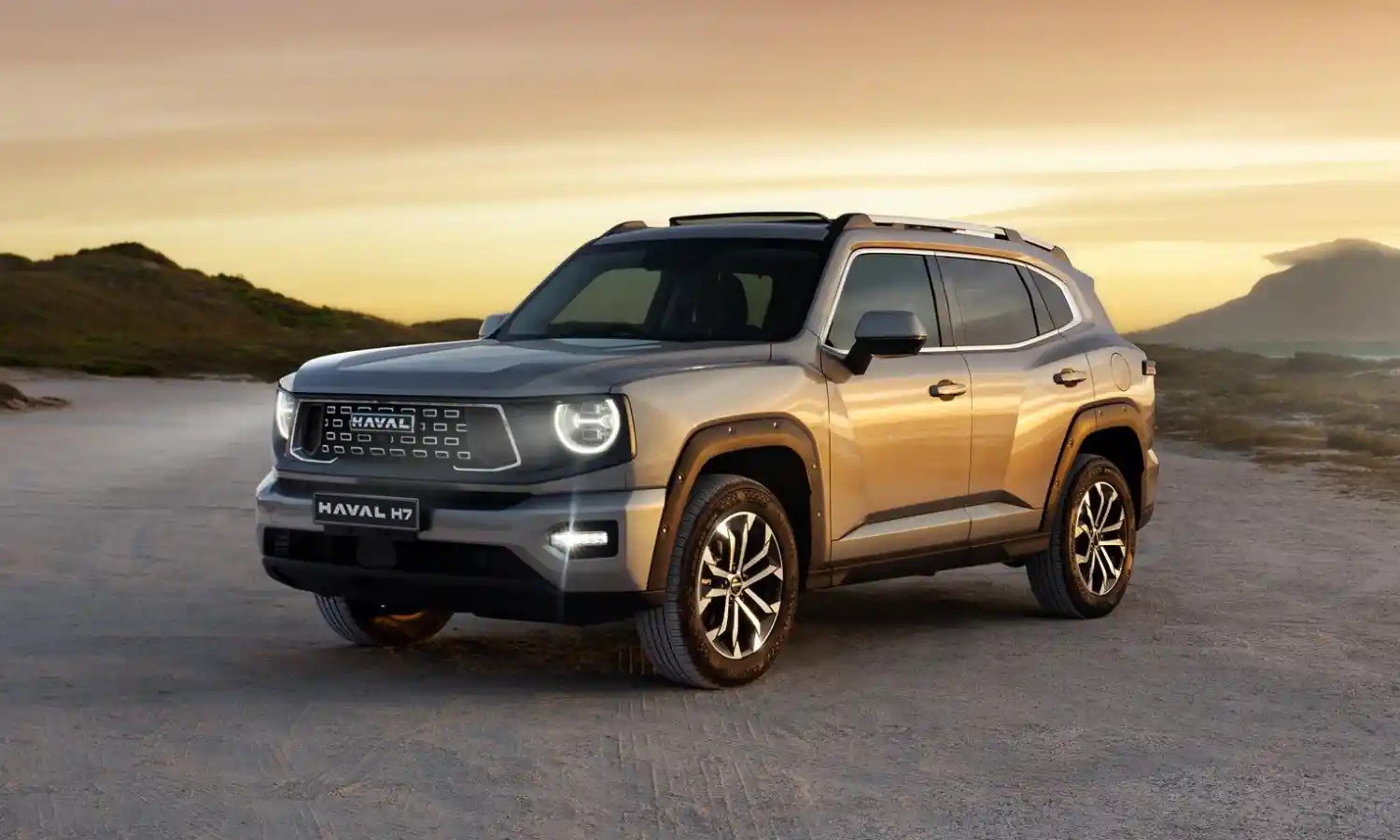
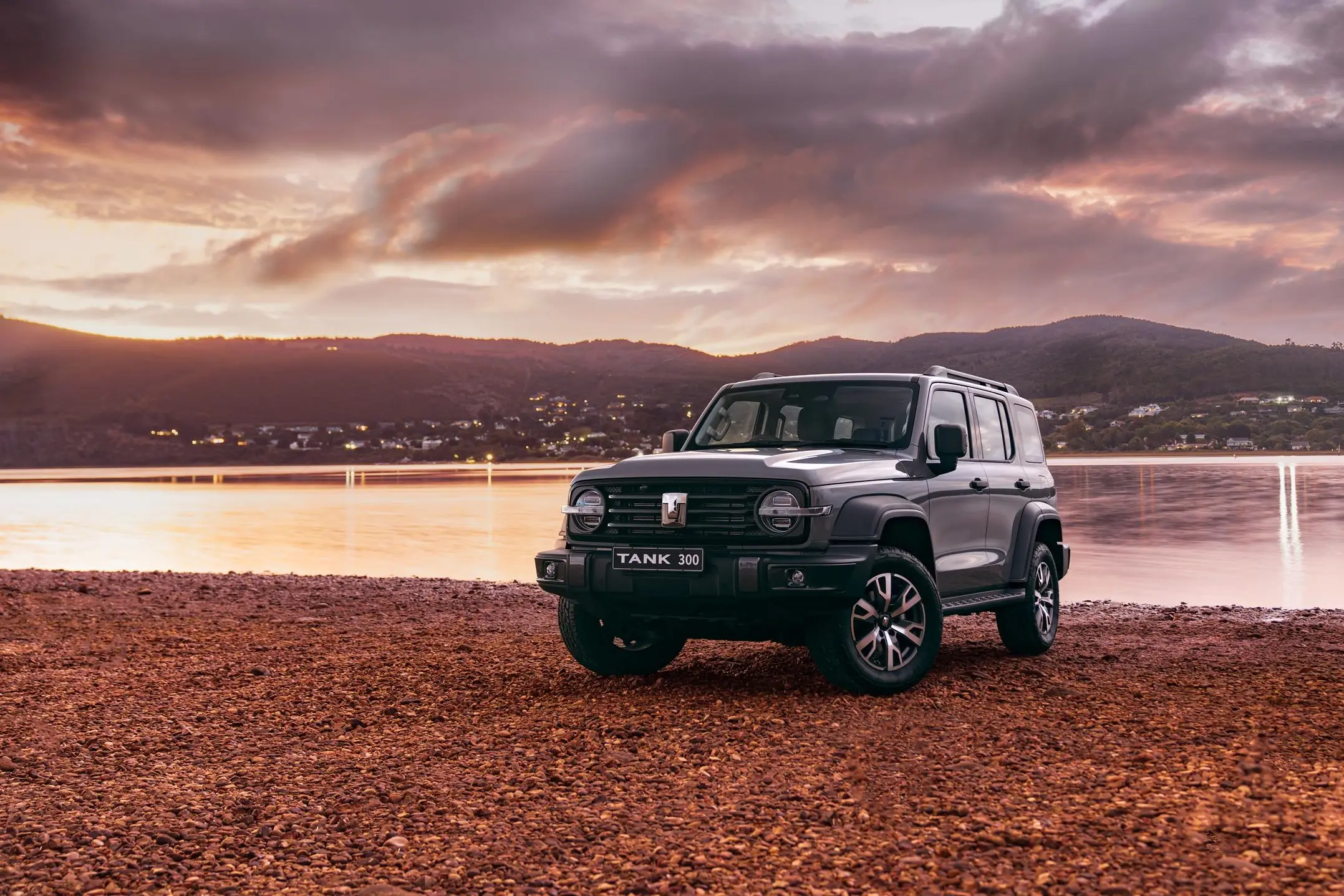
The Tank 300 is the sort of Chinese SUV that forces a reset in the usual South African ownership conversation. Most of the market still measures long-term risk by badge comfort, not by hardware, warranty length, or the size of the local dealer footprint. GWM has gone after that fear directly, and it has done so with a vehicle that looks like a proper tool, not a soft-roader in hiking boots.
On paper, the 2.4-litre diesel Tank 300 makes 135 kW and 480 N.m through a nine-speed automatic, and that drivetrain matters more than the showroom theatre around it. A smaller turbo-petrol can feel sprightly at first launch, but a diesel like this spends its life working lower in the rev range, which is kinder to the engine over distance and better suited to the sort of ownership South Africans actually do, from school runs to Karoo crossings and long stints on the N1.
The warranty is the opening argument
GWM’s 7-year or 200,000 km warranty is the headline, but the real play is confidence. The brand is telling buyers, and used buyers after them, that it plans to stay in South Africa for the long haul. The Tank 300 also comes with a 7-year or 75,000 km service plan, which means the first stretch of ownership is largely insulated from the ugly surprises that make people swear off unfamiliar brands.
That transferable warranty is where the secondhand market starts paying attention. Chery may talk loudly with its 1-million km engine cover, but that figure only belongs to the original owner. GWM’s deal is broader in feel, and that matters when a car changes hands. A used Tank 300 still carrying factory backing is easier to sell, easier to finance, and easier for the next buyer to justify. Resale value always begins as a trust exercise.
The local context helps too. GWM has been in South Africa for 18 years and now has more than 90 active dealerships. That is not a fly-by-night import story. It is a proper sales and support network, and the Tank 300 sits inside a brand that is clearly trying to outlast the scepticism around Chinese vehicles rather than simply undercut everyone on price.
The parts story is better than people think
A long warranty only matters if the car can be kept going once it falls out of the factory cocoon. Here the Tank 300’s owner experience looks reasonably sensible, with a few caveats.
Basic servicing should not scare any competent independent workshop. Oil changes, fluid flushes, cabin filters and air filters are straightforward jobs. Consumables should become easier to source as the fleet grows, and the shared 2.4-litre diesel and nine-speed automatic, which also appear in GWM’s larger P-Series and P500 commercial models, will help independent technicians build familiarity.
The catch comes when electronics enter the chat. Advanced diagnostics are a different animal because the Tank 300 uses proprietary systems and driver-assistance hardware that call for specialist tools and software. The same goes for more awkward repairs. Major engine components, specific sensors and body panels may still need to come from GWM dealers, and even with expanded regional warehouses, some structural items or back-ordered bits can still take weeks or months to land.
For owners, that means the sensible split is obvious. Let an independent handle the routine work. Keep the dealer in the loop when the job involves the transmission, ADAS faults, or anything that looks like it might turn into a parts-hunt.
The diesel choice looks deliberate
GWM did not need to launch the Tank 300 in diesel form for the sake of headline power. It did it because South African buyers understand the value of a long-legged drivetrain. A ladder-frame SUV with a diesel and a proper warranty is speaking directly to the overlanding crowd, the tow-happy crowd, and the people who have had enough of fragile crossovers dressed up with roof rails.
That rough-use credibility is supported by the vehicle’s wider engineering story. The Tank 300 launched early in markets that punish lazy products, including Australia, and there are already reports of examples crossing 150,000 km in overlanding use. None of that makes it invincible, but it does suggest GWM built something with genuine longevity in mind.
The platform is not a delicate monocoque posing as an off-roader. The ladder-frame chassis and the mechanical overlap with GWM’s workhorse range give the Tank 300 a sturdier base than many rivals can claim. In South African ownership terms, that is the sort of detail that tends to matter long after the brochures are recycled.
What happens after the factory cover ends
Once the 7-year service plan expires, the owner starts carrying more of the burden. There are still several ways to manage it without walking blind into dealer pricing.
The cleanest path is an extension through a GWM dealer or through an in-house finance administrator such as Liquid Capital. Third-party cover is also on the table, with names like MotorVaps, Innovation Group and Bidvest Insurance offering mechanical breakdown warranties and service plans. These need careful reading, because claim caps can be brutal. A gearbox failure limited to R50,000 sounds comforting until you price a modern automatic repair.
Some dealer groups have started pushing their own retention tricks. Thorp Motor Group, offers a proprietary extended warranty arrangement that can stretch to 10 years or 1 million km, provided the vehicle is bought and serviced inside its network. That is a serious carrot for buyers who plan to keep a car for ages.
There is always the self-funded route. Minor 15,000 km services can be handled by places like Bosch Service Centres or Car Service City, but differential oil changes and nine-speed transmission diagnostics are better left to a franchise GWM workshop. There is no prize for proving you can save a few rand while guessing at a complex drivetrain fault.
The Tank 300 has a stranger backstory than the badge suggests
The nameplate did not begin life as a standalone global bruiser. It started in December 2020 as the Wey Tank 300, sitting under GWM’s ultra-premium Wey sub-brand. By April 2021, after the thing outperformed expectations, it had been split out into the dedicated TANK 4×4 line.
The off-road hardware still comes from GWM’s truck and bakkie bloodline, but the interior polish has a far more upmarket origin story than the average buyer would guess.
Then there are the oddball variants. China got the Cybertank 300 in a run of 3,000 units, with a metallic body kit, Y-shaped LED lighting, a roof spoiler and an all-white interior that looks like a concept car escaped the motor show. Iron Cavalry and Frontier editions went the other way, with built-in snorkels, raised off-road suspension, heavy-duty winches and beadlock-style wheels. The Tank 330 in China adds a 3.0-litre twin-turbo V6, apparently because enthusiasts would not let the brand leave well enough alone.
There is even a hidden emergency escape latch in the rear tailgate trim, a manual way out of the luggage area if the electronics fail and the vehicle is submerged or trapped. That is not the sort of detail you expect to find on a family SUV wearing a square-jawed face. It is exactly the sort of detail that tells you GWM wanted the Tank 300 to be taken seriously long after the showroom lights are switched off.
Have your say
Got thoughts on this?
No feedback yet on How the GWM Tank 300 Is Rewriting the Chinese SUV…. Kick the conversation off.
Free. Email link only — no password.